
 Read on Twitter
I'm convinced that 2020 will be an inflection point for the American winemaking community: the year climate change got real. As I write this, I'm staring out at a dim, yellow landscape, the indistinct sunlight filtered through a thick layer of atmospheric smoke. A thread. 1/
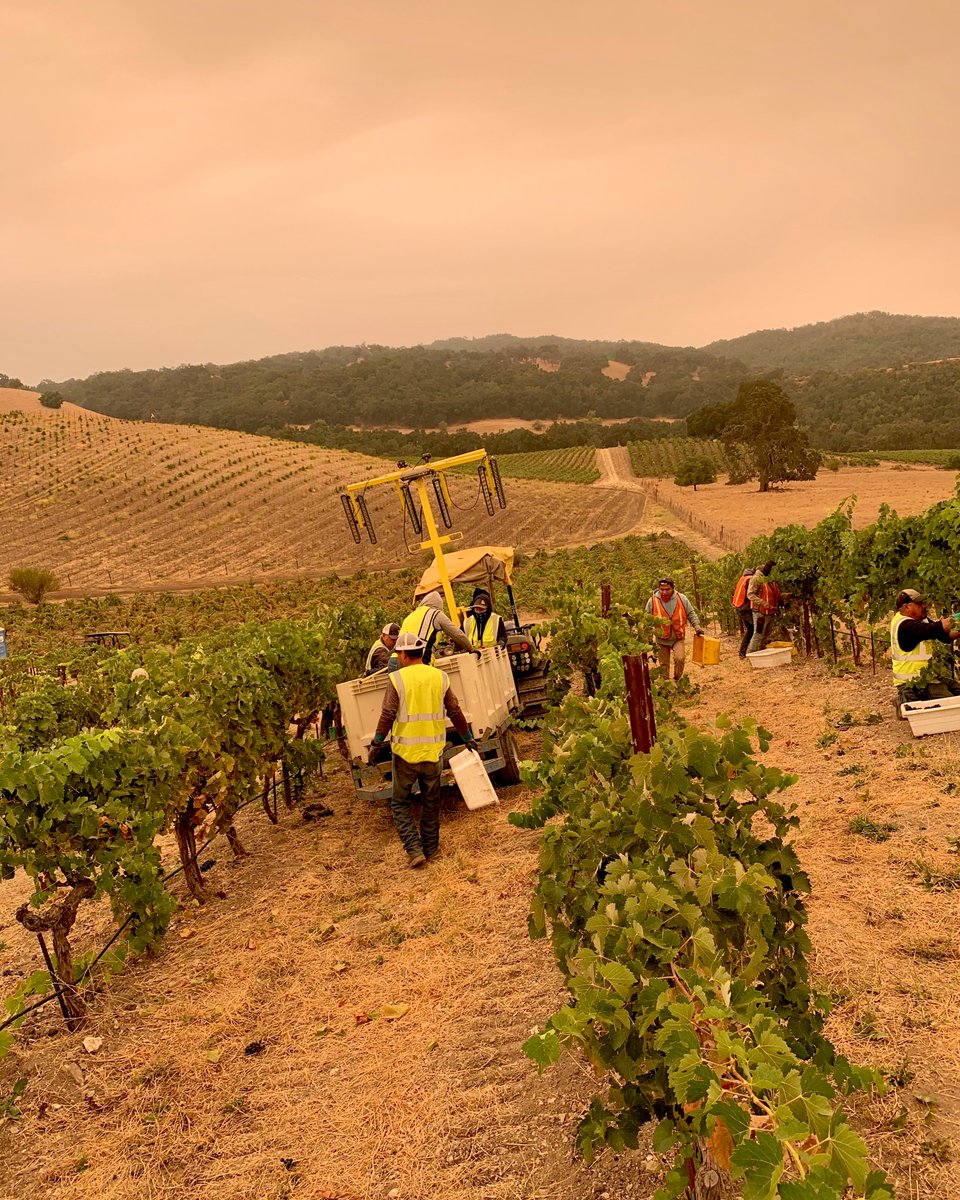
I have a sweatshirt on because the smoke layer - driven by the fact that 6 of the 10 largest fires ever in CA are currently burning (!) - is thick enough that the sun hasn't yet appeared. In prime ripening season, it's still in the 50s at @TablasCreek. https://twitter.com/Weather_West/status/1304131787140939776?s=20 2/
This smoke layer is only the most recent of a series of unprecedented things we've seen in the 2020 growing season. A week ago we had a heat wave that crested with days of 109, 113, and 111. The Paso Robles Airport broke its all-time high at 117. https://twitter.com/NWSLosAngeles/status/1302774264831963136?s=20 3/
Just two weeks ago we saw a trio of fires in the Central Coast produce so much surface smoke that we closed our tasting patio for four days because the air quality was so bad. On August 20th San Luis Obispo County had the worst air quality in the world. https://www.sanluisobispo.com/article245109120.html 4/
Those fires were sparked by a surge of tropical moisture, the remnants of Tropical Storm Fausto, that moved up the California coast and produced thousands of lighting strikes on August 14th & 15th, and fueled by a heat wave that pushed temperatures over 105°F August 15th-18th. 5/
Paso Robles is hot in the summer. Summer days of 100°F+ have never been rare here. But the increased number of these days, the fact that records are falling, the earlier and earlier beginnings to harvest, and finally the new, tropical-influenced rainfall patterns are alarming. 6/
Between 1997 & 2011 we started our estate harvest in August 40% of the years. Since 2012, we have done so 78% of vintages. Similarly, in those first 15 years, there were six times we didn't finish until November. Over the last 8 years, we haven't once harvested in November. 7/
It's not just harvest. At @TablasCreek, this year's gap between veraison and harvest was just 35 days, breaking our record of 36 (2016 & 2019). Before that, the record was 39 (2015) and before that 40 (2013). Crucial growing periods are getting hotter. https://tablascreek.typepad.com/tablas/2020/08/harvest-2020-begins-slowly-after-a-record-short-interval-from-veraison.html 8/
That's borne out in the numbers. As measured by degree days, our five hottest years have all come since 2012. Warming also impacts the Pacific Ocean, with various consequences including less rainfall (and a later rainy season) in coastal California. https://www.nature.com/articles/s41586-019-1764-4 9/
While winter rains decline, tropical-driven summer storms (like those that sparked this summer's fires) are on the rise. A warming climate produces more, larger tropical storms. 2020 has already seen so many storms that @NOAA might run out of names. https://grist.org/climate/the-2020-hurricane-season-is-tearing-through-the-alphabet-at-lmnop-speed/ 10/
The direct impacts of tropical storms on California are minor. But the more of these storms that form, the greater the chance that tropical moisture can end up in unexpected places. With tropical moisture comes lightning, producing extreme fire risk in tinder-dry summers. 11/
And while the impact of any one of these factors may be minor, taken together they combine to dramatically increase the risks of catastrophic fires here. There are now more than twice as many extreme fire risk days as there were in the 1980s. https://twitter.com/Weather_West/status/1244762995458060288?s=20 12/
Back to the impact on the American wine community. Earlier budbreaks and earlier harvests. A greater chance of major heat waves. More, and more widespread, fires raising the risk of smoke taint, disruptions to harvest, or worse. And uncertainty: not knowing what to expect. 13/
Take this smoke-induced chilly week. We're not complaining; we can catch up after last weekend's heat wave. But it's nothing we've ever seen before. Unfortunately, it sounds like unprecedented events like this are just the tip of the iceberg. https://www.buzzfeednews.com/article/peteraldhous/california-fires-record-burn-fire-apocalypse 14 & END/
Ok, one more thing. The wine community has a role to play here. In fact, it (and agriculture more broadly) has to be a part of the solution. Everyone who can should be moving to regenerative farming. The ROC program is a great place to start. https://tablascreek.typepad.com/tablas/2020/08/introducing-regenerative-organic-roc-farming-like-the-world-depends-on-it.html 15/


